
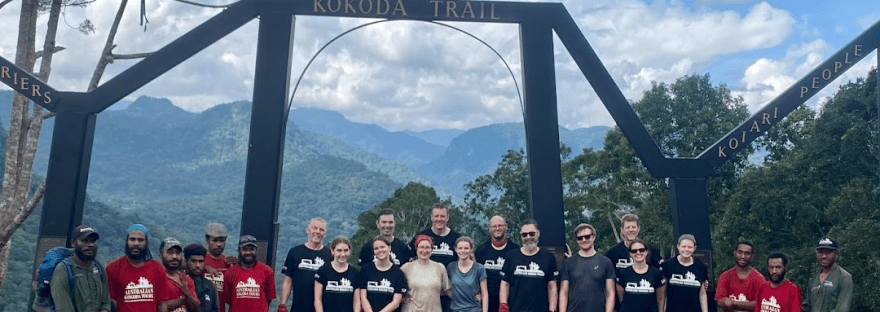
“Don’t look at the top of the mountain. Just look at your next step. Then the step after that. And the step after that.”
I had only known Jonathan for a few hours, but already he was giving me sage advice. As my ungainly figure lumbered up the first big mountain we encountered on the Owen Stanley Range, my 22-year-old porter with a mop of braids in his hair had clearly sized me up as a neophyte in need of some gentle encouragement.
Such is the lot of a porter on the Kokoda Trail, the treacherous 96-kilometre path that winds its way up and down mountains, along ridgelines and across creeks in Papua New Guinea. Each year thousands of Australians seek to walk in the footsteps of the soldiers who fought and beat the Japanese on this muddy track in an effort to repel Japan’s southward thrust during World War II.

Stories of that 1942 campaign typically centre on the stoic acts of heroism undertaken by frontline troops, trekking through mud and heat with limited supplies, often let down by senior command that is variously portrayed as ignorant or indifferent to the circumstances on the ground. And secondary roles in this wartime drama are given to the Fuzzy Wuzzy Angels, the Papuans who supported the Australians with transporting supplies and famously stretchered the injured to life-saving medical care.
In a famous newsreel Kokoda Front Line, the work of journalist Damien Parer to give Australians at the time a glimpse of what was happening on the Trail, the voiceover intones: “The care and consideration shown for the wounded by the natives has won the complete admiration of the troops.” (It then goes on to say, “With them, the black skinned boys are white.”)
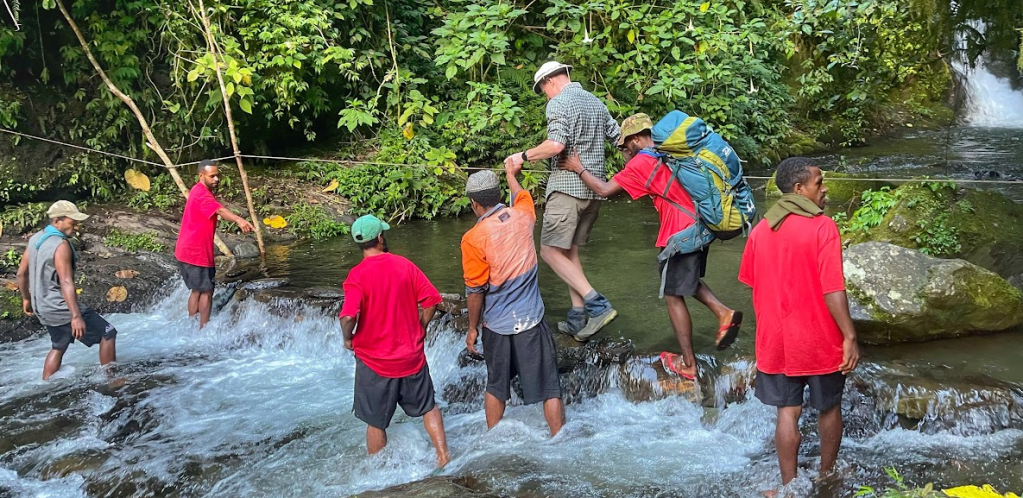
More than 80 years on, the next generation of these Angels are an essential enabling force for Australians on the Trail. Many of the porters, like Jonathan, are personal porters, carrying much of the gear of particular travellers, and others are group porters, carrying the collective supplies that are essential for a group heading into remote mountains for a week.
(Just what is considered essential? Beyond the tents, medical supplies and food staples, some porters carry giant cooking pots strapped to their sides and one we spotted on the trail was clutching a bright blue guitar.)
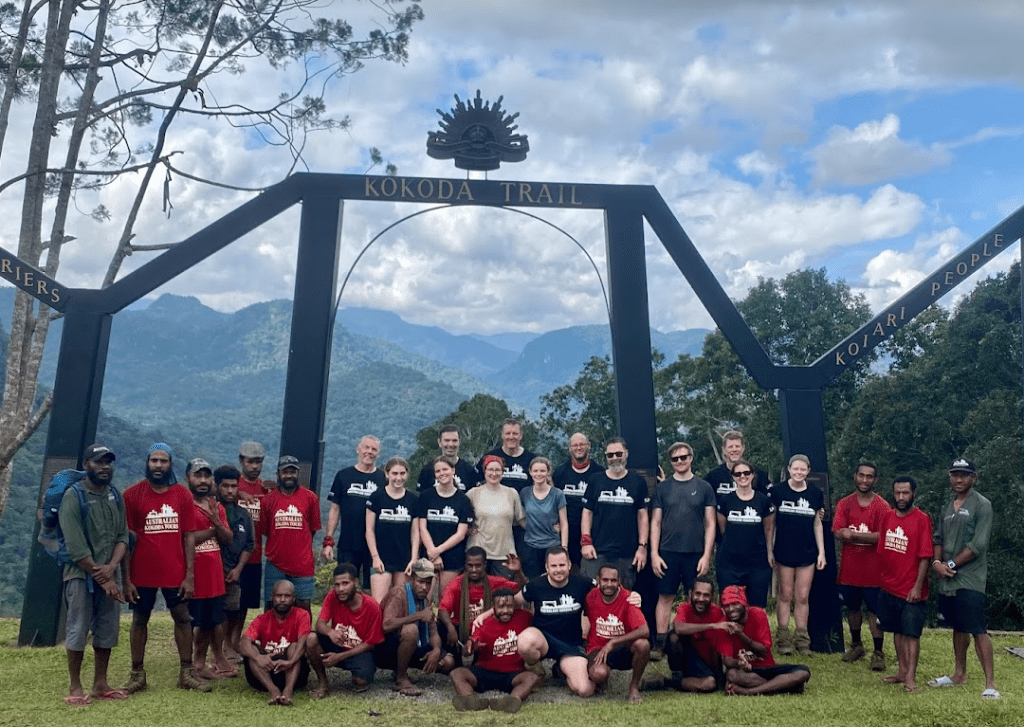
Our group of 13 Australians, a bunch of neighbours and colleagues whose age ranged from 16 to 59, quickly came to rely on these porters. We had 18 porters, with our group, a ratio of nearly one and a half porters for each trekker that is pretty typical for the groups who undertake the arduous journey.
Beyond the obvious logistical support they offer, these porters help keep trekkers upright and moving forward during the steep ascents and descents that are a hallmark of the walk, wade through waters at creek crossings to help trekkers find the optimal route and provide encouragement and morale-boosts to weary travellers, just as Jonathan had on my first day.
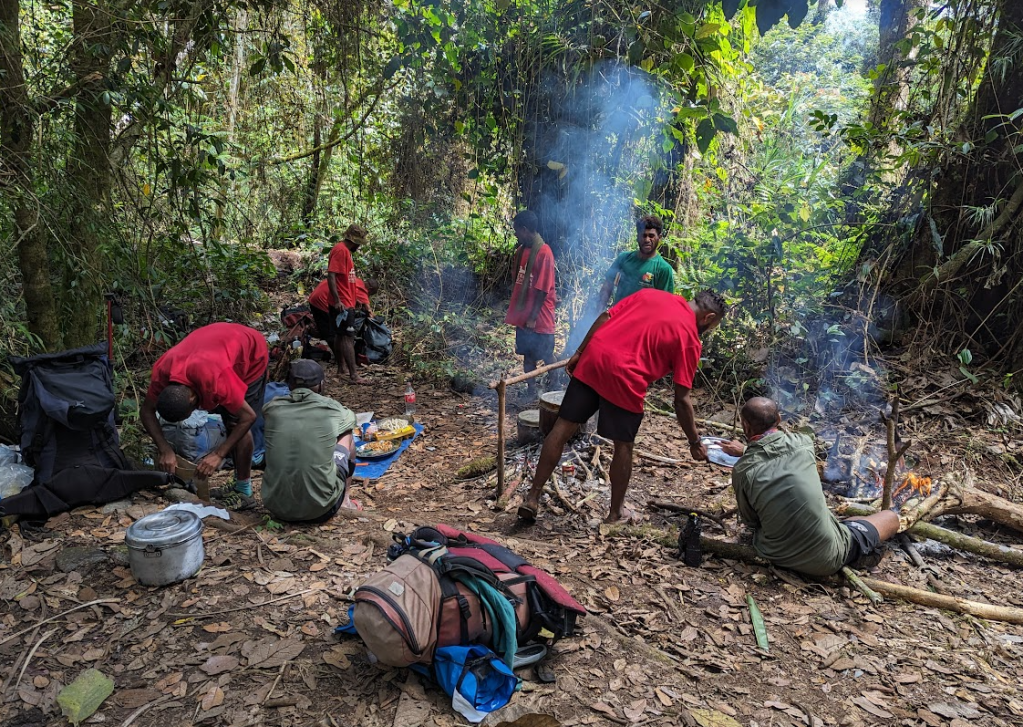
And each afternoon, as we arrive at our next camp, while the Australians rest their legs, our PNG porters continue to work – pitching tents, gathering firewood and preparing our dinner. Grumbling is entirely absent. “Just because they don’t look tired, doesn’t mean they’re not,” observes my Australian guide Matt. “They don’t like to show any sign of weakness.”
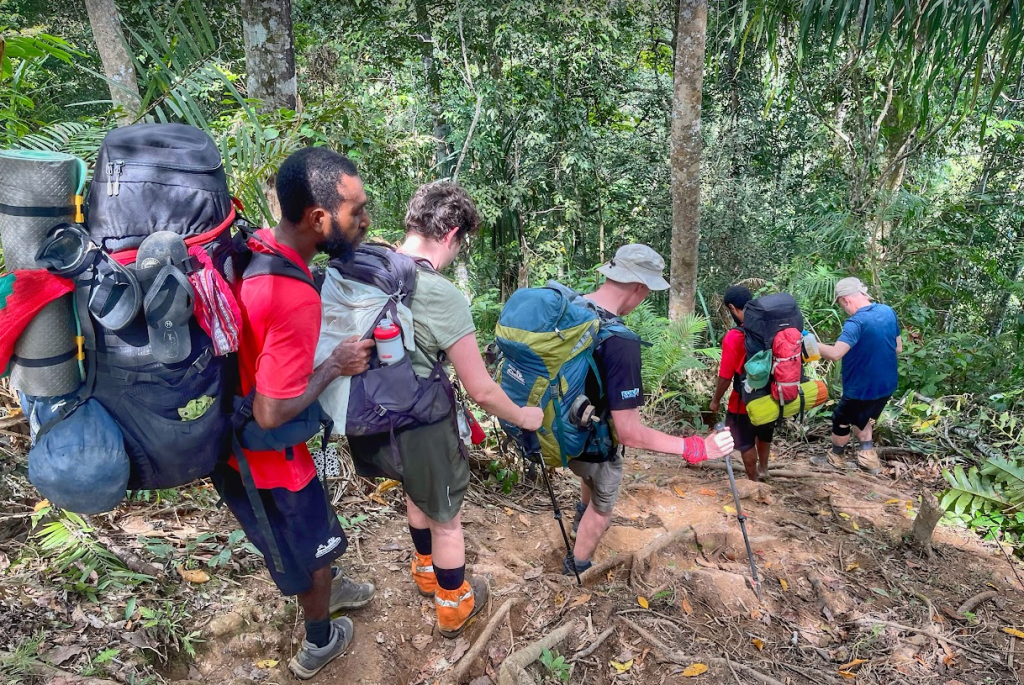
As we trudge through the mountains, Jonathan reveals some of his story to me. Unlike most porters on the trail, he is actually from Port Moresby. Not married, he has a brother and sister still at school, and works as a porter to support them. Jobs as porters are considered decent earners for people who otherwise have limited opportunities. An eight-day hike can earn a porter around A$700, a decent amount in a country where GDP per person stands at just A$4,500.
The porters share much in common. Some things are obvious from our first hour together – they are all fit young men, most are from the mountain villages that freckle the Owen Stanleys, they are enamoured with Rastafarian cultural markers and bring endless reserves of energy.
But other details about our porters only become clear as our week progresses. Most porters are devotees of the Seventh Day Adventist Church, which since the arrival of missionaries early last century has had a strong grip on the communities along the Kokoda Trail. The influence of the church becomes clear during the trek, as our porters lead an evening sing-sing filled with tunes reminding us that Jesus walks with us on the road to Port Moresby, and later as they abstain from the usual revelry on Saturday, the Sabbath for Seventh Day devotees.
Four days into our trek we make it to the village of Kagi, high in the mountains. This is where many of our porters come from, and their families are keen to welcome us to the village. As a church service comes to a close, our group of trekkers are corralled into a line for a welcome ceremony. A church elder offers some words of encouragement for the trek, before families sing a song with voices that carry the resonance of a life spent in church choirs. Later we share some balls with the children and play with them on a dusty field, the children bustling with energy as they demonstrate their rugby league prowess.
Back on the trail, I note that while the feet of trekkers in our group are clod with trail shoes or hiking boots, many of our porters are either barefoot or in flimsy sets of thongs. Those who grow up poor in the mountains develop feet with an affinity for the landscape, it seems. And it works for them – even as the Australians were slipping and sliding, our thonged porters stayed upright. “This is how we’ve always done it,” one porter explains.

As the final day arrives, we carry our lumbering frames up one final steep ascent to the heroic arch at Owers’ Corner. Soon after I cross the finish line I collapse to the ground, my energy spent. Jonathan checks if I’m okay, and I nod in the affirmative. Later that night at a farewell dinner back in Port Moresby, he hands me a wood log carving he has made across the week. It is an apt memento, with my name and a silhouette of trekkers on its side. It also carries a phrase in Tok Pisin. “Insait lo leg mak blo masalai.” “You are walking with the spirits,” Jonathan answers my unspoken question. A step ahead the whole way.
I walked the Kokoda Trail with a team from Australian Kokoda Tours. Thanks to founder Mick O’Malley and our guide Matt Bragg. Thanks to everyone in our group (June/July 2023) for making the experience possible, and for supplying photos. And deepest thanks to the many porters who kept us happy, safe and well fed. This article first appeared in the October 2024 edition of Paradise, the inflight magazine of Air Niugini (available via PDF and Issuu).

 Ari Sharp