Uncategorized

Still angels: A tribute to the porters of Kokoda

“Don’t look at the top of the mountain. Just look at your next step. Then the step after that. And the step after that.” 

I had only known Jonathan for a few hours, but already he was giving me sage advice. As my ungainly figure lumbered up the first big mountain we encountered on the Owen Stanley Range, my 22-year-old porter with a mop of braids in his hair had clearly sized me up as a neophyte in need of some gentle encouragement. 

Such is the lot of a porter on the Kokoda Trail, the treacherous 96-kilometre path that winds its way up and down mountains, along ridgelines and across creeks in Papua New Guinea. Each year thousands of Australians seek to walk in the footsteps of the soldiers who fought and beat the Japanese on this muddy track in an effort to repel Japan’s southward thrust during World War II. 

Kokoda offers some magnificent vistas. Photo courtesy of Sean Collins.

Stories of that 1942 campaign typically centre on the stoic acts of heroism undertaken by frontline troops, trekking through mud and heat with limited supplies, often let down by senior command that is variously portrayed as ignorant or indifferent to the circumstances on the ground. And secondary roles in this wartime drama are given to the Fuzzy Wuzzy Angels, the Papuans who supported the Australians with transporting supplies and famously stretchered the injured to life-saving medical care.  

In a famous newsreel Kokoda Front Line, the work of journalist Damien Parer to give Australians at the time a glimpse of what was happening on the Trail, the voiceover intones: “The care and consideration shown for the wounded by the natives has won the complete admiration of the troops.” (It then goes on to say, “With them, the black skinned boys are white.”) 

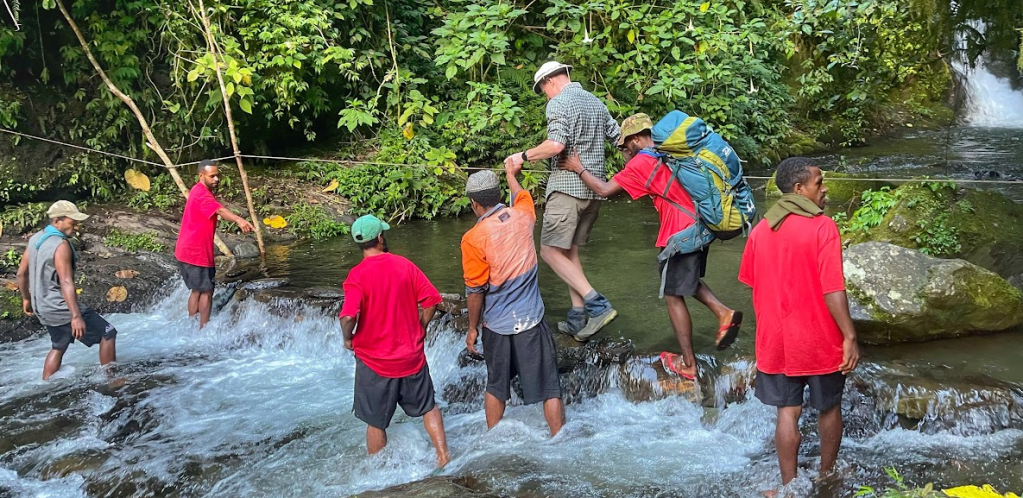
Porters kept us safe (and mostly dry). Photo courtesy of Will Harper.

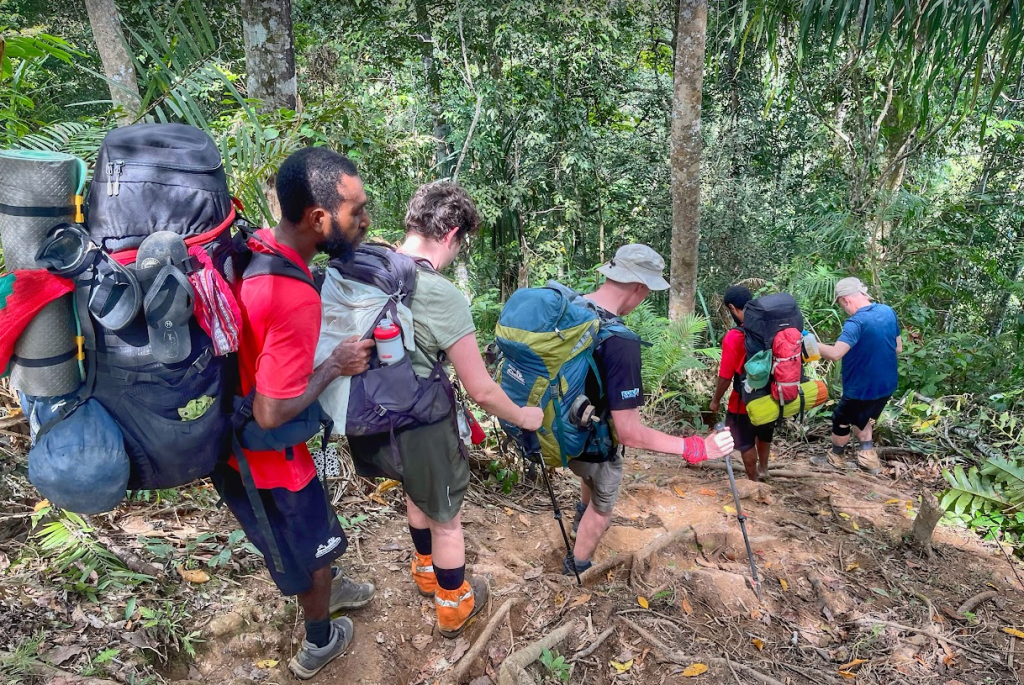
More than 80 years on, the next generation of these Angels are an essential enabling force for Australians on the Trail. Many of the porters, like Jonathan, are personal porters, carrying much of the gear of particular travellers, and others are group porters, carrying the collective supplies that are essential for a group heading into remote mountains for a week. 

(Just what is considered essential? Beyond the tents, medical supplies and food staples, some porters carry giant cooking pots strapped to their sides and one we spotted on the trail was clutching a bright blue guitar.) 

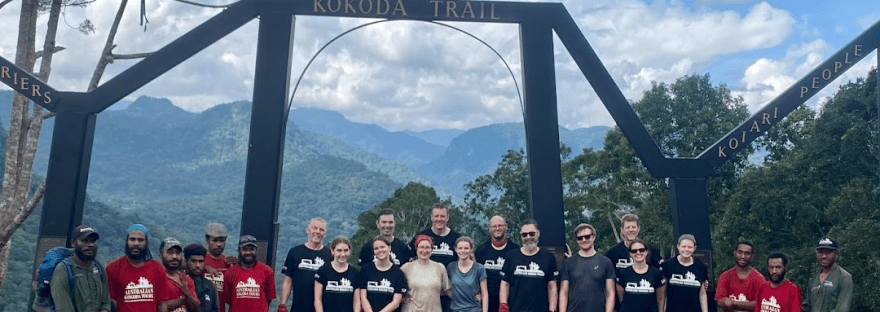
Our group of 13 Australians, a bunch of neighbours and colleagues whose age ranged from 16 to 59, quickly came to rely on these porters. We had 18 porters, with our group, a ratio of nearly one and a half porters for each trekker that is pretty typical for the groups who undertake the arduous journey.  

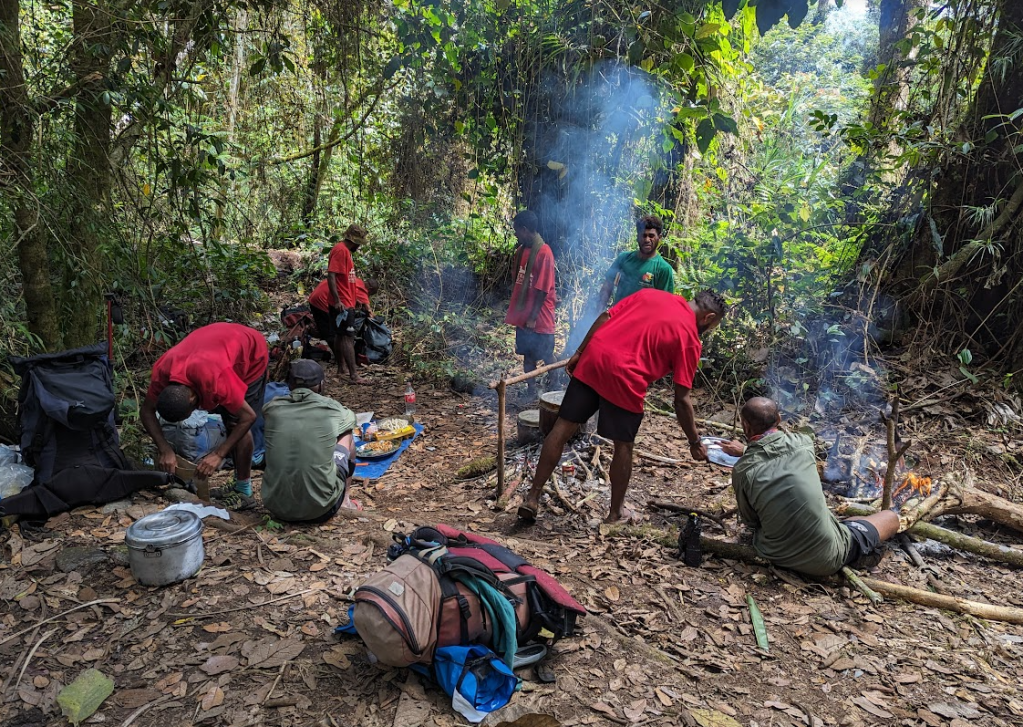
The porters whipped up some remarkably good tucker. Photo courtesy of Andrew H.

Beyond the obvious logistical support they offer, these porters help keep trekkers upright and moving forward during the steep ascents and descents that are a hallmark of the walk, wade through waters at creek crossings to help trekkers find the optimal route and provide encouragement and morale-boosts to weary travellers, just as Jonathan had on my first day.  

And each afternoon, as we arrive at our next camp, while the Australians rest their legs, our PNG porters continue to work – pitching tents, gathering firewood and preparing our dinner. Grumbling is entirely absent. “Just because they don’t look tired, doesn’t mean they’re not,” observes my Australian guide Matt. “They don’t like to show any sign of weakness.” 

The backpack technique of the porters was quite brilliant. Photo courtesy of Will Harper.

As we trudge through the mountains, Jonathan reveals some of his story to me. Unlike most porters on the trail, he is actually from Port Moresby. Not married, he has a brother and sister still at school, and works as a porter to support them. Jobs as porters are considered decent earners for people who otherwise have limited opportunities. An eight-day hike can earn a porter around A$700, a decent amount in a country where GDP per person stands at just A$4,500. 

The porters share much in common. Some things are obvious from our first hour together – they are all fit young men, most are from the mountain villages that freckle the Owen Stanleys, they are enamoured with Rastafarian cultural markers and bring endless reserves of energy. 

But other details about our porters only become clear as our week progresses. Most porters are devotees of the Seventh Day Adventist Church, which since the arrival of missionaries early last century has had a strong grip on the communities along the Kokoda Trail. The influence of the church becomes clear during the trek, as our porters lead an evening sing-sing filled with tunes reminding us that Jesus walks with us on the road to Port Moresby, and later as they abstain from the usual revelry on Saturday, the Sabbath for Seventh Day devotees.

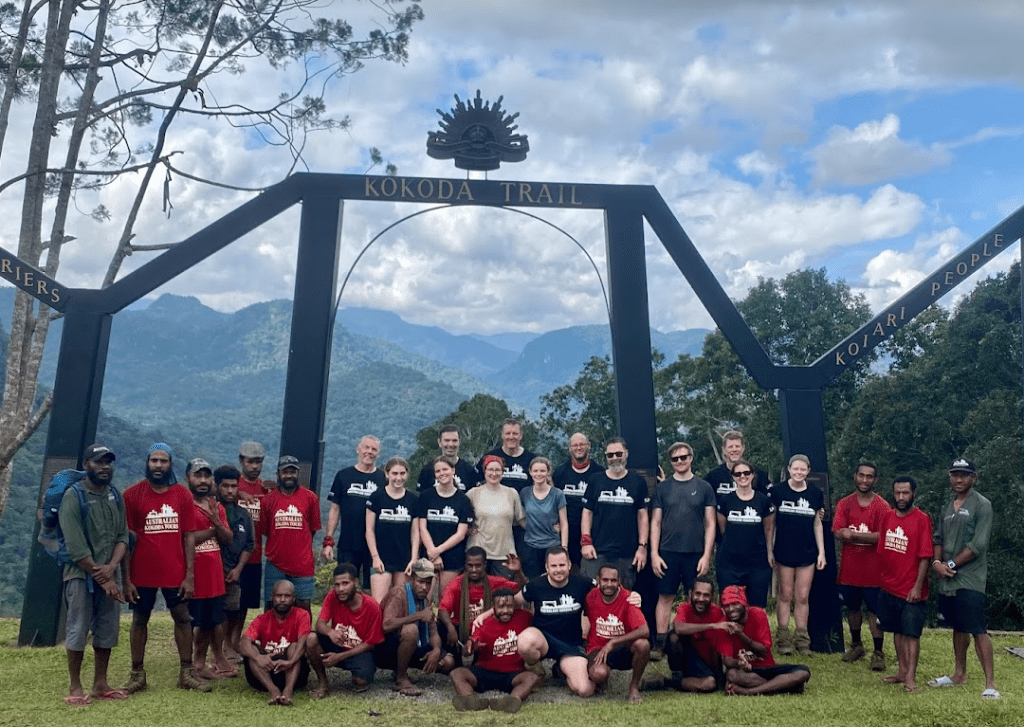
We made it to Owers’ Corner. Photo courtesy of Bronwyn Hinz.

Four days into our trek we make it to the village of Kagi, high in the mountains. This is where many of our porters come from, and their families are keen to welcome us to the village. As a church service comes to a close, our group of trekkers are corralled into a line for a welcome ceremony. A church elder offers some words of encouragement for the trek, before families sing a song with voices that carry the resonance of a life spent in church choirs. Later we share some balls with the children and play with them on a dusty field, the children bustling with energy as they demonstrate their rugby league prowess. 

Back on the trail, I note that while the feet of trekkers in our group are clod with trail shoes or hiking boots, many of our porters are either barefoot or in flimsy sets of thongs. Those who grow up poor in the mountains develop feet with an affinity for the landscape, it seems. And it works for them – even as the Australians were slipping and sliding, our thonged porters stayed upright. “This is how we’ve always done it,” one porter explains.  

My porter Jonathan was the embodiment of patience.

As the final day arrives, we carry our lumbering frames up one final steep ascent to the heroic arch at Owers’ Corner. Soon after I cross the finish line I collapse to the ground, my energy spent. Jonathan checks if I’m okay, and I nod in the affirmative. Later that night at a farewell dinner back in Port Moresby, he hands me a wood log carving he has made across the week. It is an apt memento, with my name and a silhouette of trekkers on its side. It also carries a phrase in Tok Pisin. “Insait lo leg mak blo masalai.” “You are walking with the spirits,” Jonathan answers my unspoken question. A step ahead the whole way. 

I walked the Kokoda Trail with a team from Australian Kokoda Tours. Thanks to founder Mick O’Malley and our guide Matt Bragg. Thanks to everyone in our group (June/July 2023) for making the experience possible, and for supplying photos. And deepest thanks to the many porters who kept us happy, safe and well fed. This article first appeared in the October 2024 edition of Paradise, the inflight magazine of Air Niugini (available via PDF and Issuu).

Parenting

Where are all the dads?

Curious about the lack of hands-on fathers, I hunted down the evidence and wrote this piece more than a year ago. My circumstances have changed a bit since then, but the central argument is as strong as ever. Love to hear your thoughts.

“IF YOU’RE happy and you know it clap your hands,” I jauntily sing, a rictus grin pinned to my face and my palms mashed together. My daughter Amelia, nuzzled in my lap, looks at me quizzically and makes little movement to match my impression of a performing seal.

So goes another Tuesday morning at Dickson Library, where an army of under-threes and their big people take over the mat for a half hour of songs and stories. “Giggle and Wiggle” has become such a hit in this pocket of inner-north Canberra that the library schedules two sessions back to back, and tickets are distributed online at 7am on the day.

Looking out at the few dozen parents whose fast fingers have secured them a ticket, it is evident I am the only dad. While there are sporty mums and homebody mums and underslept mums and juggling-several-kids mums camped out on the carpet with their little ones, dads are nearly absent from the swirling humanity.

Our typical absence from the scene makes us a novelty when we are there. The presence of a father on the carpet is a source of bemusement for many of the kids, who eye me off as if I’m an alien who just joined the checkout queue at Woollies. The mums play it cooler than their uninhibited offspring, but still glance my way to check I have mastered the thumb-and-index finger movements on Incy Wincy.

Such is life as a hands-on father. Even in an era when many people gleefully smite stereotypes and where women are making strides in the workplace, it is still rare to see men being the primary carers for their offspring. Sure, there are many hands-on dads on evenings and weekends changing nappies and pushing on swings in a way that would have been an anathema to their grandfathers, but there are few who are filling their days with it as their primary activity.

About 68,500 Australian two-parent families have at-home fathers, compared to 495,600 with at-home mothers, according to the Australian Institute of Family Studies. But after the proportion rose from almost nothing to 4 per cent by 2001, it has since plateaued there. (By comparison, the proportion with at-home mums sits at 31 per cent, with both parents working at 57 per cent and with neither parent working at 7 per cent.) So even over decades when increasing numbers of women are heading to work, the proportion of dads manning the craft box has stayed steady.

In her 2015 book The Wife Drought, Annabel Crabb explored the effort to increase female workforce participation. “What if we are looking at things the wrong way?” she asked. “What if the structural problem here is not just how to get women into the workplace, but how to get men out of it? All this time we’ve been trying to win equality by eliminating the disadvantages women incur when they take time out to have children. But what it we just accepted that people might well be disadvantaged when they take time out of work, and concentrated instead on spreading the responsibility around?” Bingo.

The barrier to more hands-on fathering is not a legal one. Fathers are now as entitled to parental leave and other forms of workplace flexibility as mothers are, and face protections from discrimination should they seek to use them. But having a legal entitlement to it is very different to a social entitlement.

“As a lawyer, I do not know any men that manage to work part time without drawing criticism, and in my view, limiting their career progression,” said Adam, a Melbourne dad who puts his share of the caring load for his 4-year-old son at just under 40 per cent. “It is certainly the case with women also, however there is an expectation that women will be more likely to work part time and that men should ‘want’ to work full time.”

And just what is the source of this expectation? When asked in a HILDA study whether children do just as well if the mother earns the money and the father takes care of the home and children, only 50 percent of fathers and 57 percent of mothers said they agreed. That’s a lot of people who declined to endorse this seemingly anodyne statement. Clearly many people remain uncomfortable with the idea of fathers as primary carers even as they mouth the platitudes of gender equality and progressive social roles. To understand just why men are so rarely being hands-on dads we need to look at the construction of masculinity in Australia, and the way that male identity is often bound up in vocation.

FIRST, though, consider demographics.

Take an archetypal couple: a woman with an older male partner. If both partners are advancing their careers at the same rate, the age difference means the man will be more advanced at any given point. When babies come along, it makes sense that the couple will choose to forgo the lesser income, hence the woman taking the longer period of parental leave and perhaps only returning to work part-time afterwards. Over time the professional advancement gap between the two parents widens, increasing the economic incentive for the lower income earner to be the primary carer.

But fewer and fewer of us are living that archetype. For starters, there are plenty of same-sex couples with children, and single-parent families. Then there are heterosexual couples in which a younger man partners up with an older woman, and the growing number of households in which women are out-earning men.

The demise of male-dominated factory jobs and the rapid growth of female-dominated health and education jobs has improved earning opportunities for women, while equal pay for equal work has belatedly permeated parts of the economy that previously hid behind sexist pay policies. Women today have more earning opportunities than did their mothers and grandmothers, so it follows that they are either the leading breadwinner in households, or have a negligible income gap with their partners.

With this archetype slowly being eroded, you would expect more men to become primary parents. After all, if economic logic is guiding your behaviour, when a child is born and the mother is the higher income earner, it makes sense for her to get back to work as soon as possible after recovery from birth, and for the man to take a longer period of parental leave or part-time work.

But that does not seem to be the case. There is evidence that in a vast majority of heterosexual households, it is the woman who takes on primary caring responsibilities for their children, even when she is the higher income earner.

Boffins from the National Bureau of Economics Research in the United States looked at this in 2013. They found that in households where a wife earns more than her husband, she takes on an even greater share of household tasks (including childcare) than in typical households, which are already heavily weighted towards women doing unpaid work at home. “One explanation for the observed pattern is that, in couples where the wife earns more than the husband, the ‘threatening’ wife takes on a greater share of housework so as to assuage the ‘threatened’ husband’s unease with the situation,” the researchers wrote. It is unlikely that things are much different in Australia.

Why are couples so keen to ensure that mothers are taking on primary care roles? Or to put it another way, why are couples so keen to ensure that fathers are spared from primary care roles?

A FEW MONTHS into my time as a hands-on dad, my wife and I left our daughter with her grandparents and headed to a dinner party. Much as I love spending time with Amelia, it was a small relief to enjoy the company of adults for an evening, finally spared the need to wipe a snotty nose and interpret babble. It was a fun gathering of people from across Canberra, the usual mix of public servants, journalists and government affairs types, chowing down on a pot-luck selection of risottos, curries and quinoa salads.

As the conversation rambled on and people volunteered some gossipy tidbits from their various lines of work, I awaited the question that would inevitably come my way. “So what do you do?” I shared the truth about my circumstances, and was rewarded with some mushy praise from enlightened types for whom respite from the professional rat race is a stated objective even if rarely enacted. But suddenly my domain of expertise was shrunk from the world at large to my home, and at a stretch, to my neighbourhood, with anything I might have proffered on the state of the planet discounted accordingly.

It is a belittling that generations of women have complained about, and right then I was feeling its sting.

For many people, our occupation is an integral part of our personal identity. It informs how we see the world, but also how others see us. It is a reflection of the skills, knowledge and commitment of which we are often proud. Clearly it applies to people of both genders, but for many men, denied the primal capacity to bear a child and give birth, our achievements at work are often the greatest accomplishment we have.

To be a man without work (and the income that goes with it) is a humbling experience that invites a pitied response from others. Couple that with a breadwinning wife who is putting in the hours at work, and the sensation is emasculating – a word that has fallen out of favour in an era of supposed gender-blindness but still carries plenty of heft for a man experiencing it. The data offers some clues in how at-home fathers are responding to that emasculation. When the Australian Institute of Family Studies crunched HILDA data, it found that even in households with at-home dads, mothers are more likely than fathers to take on the lion’s share of housework and getting children dressed.

The obvious rejoinder is for us to mentally categorise child-raising as a form of employment. But such a label is problematic in that it turns an act of love into a burden. Many of us cringe at a father whose looking after his own children is described as “baby sitting”, thereby grouping it in with childcaring-as-employment rather than childcaring-as-love. To extend this mis-description to the primary activity of an attentive father seems wrong.

Perhaps the answer lies in creating the social expectation that both parents will make a significant professional sacrifice in order to take care of their children. Paid parental leave is available to most working parents, and employers are obliged to consider requests for significant extra unpaid parental leave. It is not unreasonable for each parent in a two-parent household to take an extended period of time to be the primary carer for pre-school-age children. Countries in Scandinavia have introduced parental leave entitlements that need to be shared among both parents, and perhaps something similar might work here.

As it stands in Australia, the emasculation of reducing paid work commitments in order to take on parenting responsibilities comes from the sense that not only are you doing it, but you have chosen to do it. Were this to be the default setting for more couples, it would change that parameters of the conversation – a father reducing paid work to care for children would be the standard approach and opting not to do it would be the choice.

Author Tim Winton has spoken out recently about the rise of toxic masculinity among Australian men, in which rank displays of misogyny have become pervasive. “So often I see boys having the tenderness shamed out of them,” he put it. Much of that toxic masculinity is grounded in enduring perceptions of the rightful roles of men and women, with a generation of men feeling threatened by the challenge to their position of cultural privilege, and so lashing out in a desperate bid to reassert their waning dominance. While calling out displays of toxic masculinity is a worthy endeavour, it does little to prevent the rise of future generations of boys adopting these behaviours.

Far more constructive is an effort to broaden ideas of the rightful roles of gender. Already this is happening in the advancement of women in the workplace, but it is only in its infancy in the advancement of men in the domestic sphere. Making emphatic the idea that real men play with their kids may open the eyes of many young men to their full potential. What better way to preserve the tenderness Winton observed?

BUT THIS furrowed-brow approach to the issue ignores a central fact of which I have become deeply aware this past year: hands-on parenting is a heck of a lot of fun. Rather than grinding through the hours and days like I imagined I might, parenting my daughter has been a joyous experience in which many days have flown by in a whirr of galleries, parks and libraries.

To be a hands-on parent is to be the biggest single influence on the life of a child, and to instil the behaviours that will last a lifetime. Perhaps the most satisfaction I have got out of the experience is to see the best of my actions reflected back at me – Amelia mimicking my habit of returning things to their right place by volunteering to put away her scattered Duplo – while the biggest disappointments have been to see some of my worst qualities on display in her – Amelia letting her frustrations show just as I occasionally let the angst of the day get to me.

Days out and about with a child allow you to rediscover the place you call home. While revisiting places of culture (high and low) can become tiresome on your own, done in the company of a child it offers a whole new perspective. It is a simple pleasure to wander through Canberra’s underappreciated National Portrait Gallery, as we have done many times, pointing out the quirky details on the works on show to a little person eager to see the next one and the next one and the next one.

Even the most unpleasant parenting task can become a thrill if framed the right way. What if a dirty nappy in a shopping centre prompted not a resigned shrug about the necessary course of action, but instead a Mission: Impossible logistical stunt, in which the two of us dart around for a flat surface that could suitably act as a change table while considering what toiletries supplies we can repurpose? We all need ways to make ourselves the heroes of our own lives, and as I successfully wiped away the detritus from my daughter, I’d briefly found mine.

Watching mums and dads with their offspring in a busy park, you cannot help but notice the different parenting styles each gender often adopts. Many mums linger close to their children, conditioned to be on hand for any contingency, while many dads hold back, giving their children space to move and figure out things for themselves.

It can be tempting to perceive the fathers taking this approach as distant, physically and emotionally, failing to fulfil the parental obligation to shield their children from the dangers of the world. But look closer and you will see that these are just fathers with their own style, showing their love for the children by allowing them to make their own mistakes and discover things on their own terms. If we want dads to play a more active role, we need to accept that they will often “do” parenting differently to mums, and spare the tut-tutting that may be tempting.

There’s plenty of evidence that a hands-on father can make a positive difference to children’s lives. According to Dr Leanne Lester’s analysis of the Longitudinal Study of Australian Children, the presence of a father (or father figure) can be correlated with higher NAPLAN performance, greater rates of school attendance and even lower body mass index scores. “Children have significantly better health, academic, social and emotional outcomes when their fathers have a consistently warm parenting style,” she found.

AS I GOT ready to return to work part-time after a dad break, I looked back on how I had invested the past year. My wife and I had had some grandparental assistance, and I had taken some time to study, but a majority of my waking hours had been spent looking after Amelia. I’d seen her grow from an adorable infant into an insatiably curious toddler, full of her own ideas about how the world should be.

The morning of my first day back at work, I was getting Amelia dressed for preschool and we were having a standoff over socks. She thought they were unnecessary, but I demurred. When tasked with selecting a pair from sock drawer, she opted for a garish panda-themed pair, that even me, as a helplessly unfashionable type, could tell was a bad fit with the rest of her outfit. “I want these,” she implored with a doe-eyed plea. Fair enough.

As she marched out the door in her panda socks, I hung back and admired. It had been a damn good year, and there were plenty more like that ahead. Wouldn’t miss it for the world.

Tokyo

Looking for new ways to feel inadequate? Try a sento bath

I’m rather fond of my technique for slipping off shoes. I’ve invested in a pair of Hush Puppies, which cling snugly to my foot without the aid of shoelaces. So long as I’m sober and have some space, I can gently elevate my right heel and slide the ball of the foot down to the opening. At just the right moment the knuckles of my toes are close to the edge, so when I glide my right foot up along the back of my left leg, my left hand is ready to slip the shoe off. Do the same on the other side and I’ve freed my feet from their shoes, no bending required.

Deploying this technique got my visit to my neighbourhood sento off to a rocking start. While Japan’s onsens get plenty of attention for their idyllic soaking experience, it is to sentos that people head in urban areas for a wash and a bath. Dating back to a time when in-home bathing options were scarce, sentos became a communal spot for keeping clean and inevitably a place for gossip and intrigue. Nowadays they are a cherished relic of a bygone era, one plenty of Japanese use daily.

There are hundreds of sentos across Tokyo, most of them family owned and passed down through generations. From the street they have a quiet, understated look, often with just a small curtain hanging over a modest entrance. Despite this lack of Big Sento calling the shots, each have remarkable similarities in the experience they offer.

Heading in

With my shoes in hand I was ready for my first test of the unspoken rituals of the sento. I browsed the small lockers seeking the spot to rest my Hush Puppies. A handful of the lockers had keys dangling with metal cards attached, while those without keys had shoes visible through the small display window. I picked my slot – the low ones were no place for a Gaijin to reach and the tall ones would have just been showing off – popped my shoes inside and took my key.

After I stood expectantly at the automatic door, waving my arms with increasing vigour, an elderly lady with her hair in a neat bun approached from behind and hit the button, prompting the door to slide open. “Arigato,” I mumbled in quiet shame.

Neat Hair Lady continued ahead of me to the counter in the modest foyer, where she stacked some 100-yen coins on the counter. As I stood behind her I looked at the toiletries arranged neatly in a basket: small bottles of soap and shampoo, some cheap razors in plastic, single-use toothbrushes and toothpaste, and a collection of fluffy white objects awaiting insertion in a cavity of some sort or another.

The elderly lady’s stack of 100-yens replaced with some copper coins in a tray, she grabbed her change and ventured through the curtain to the right of the counter. Now it was my turn.

I stared intently at the Japanese sign posted to the side of the counter, with a blizzard of unrecognisable kanji (for me, that’s pretty much all kanji) and a scattering of numbers. I was none the wiser. The bored young attendant took pity on me. “First time?” Sento Scion asked me. I nodded gormlessly. “Four-sixty yen,” he said. “Need a towel?” My desire to travel light had left me without one. “Hai,” I said, my Japanese fooling no-one. He reached below the desk and took out a cheap yellow towel in plastic. “You wash?” Without waiting for an answer he grabbed a sachet of soap and another of shampoo and added them to the pile. I handed over my thousand yen note and received a tinkling of coins. Sento Scion nodded to the left of the counter, and I ventured through the curtain.

Taking off

Three steps up a passage and I found myself inside the male dressing room. Blokes stood around in various states of undress, one salaryman-type without trousers resting forlornly on a wooden bench, an old bloke fashioning a combover in front of the mirror and a young stallion with a cowlick standing on the scales and admiring the outcome. The walls on two sides were lined with lockers, keys in the locks of some, although this time the keys had a spring of coiled plastic attached. I opened one.

I placed my towel and toiletries on top of the locker, along with the shoe key, then proceeded to undress. I shoved my shirt and pants inside, then unclasped my watch. I glanced around the changeroom, keen not to catch anyone’s gaze. On a wall was a poster encouraging good sento manners, with cartooned images and bilingual captions imploring people to take off all their clothes, to avoid running and to wash thoroughly before entering the bath. This last one seemed to carry the implicit postscript, “We’re talking to you, Gaijin”.

Becoming desensitised to the saggy male flesh on display, I overcame my fleeting inhibitions and removed my socks, then my underwear. No shame in nakedness if we’re all that way. I put the socks and jocks in the locker, shut the door and turned the key. Or tried to. The key refused to budge, so drawing on generations of family wisdom, I tried to force it. No movement.

Diverting from his path to the exit, Combover Man stepped my way. He muttered a phrase I didn’t catch, though could probably guess, and reached above the locker to the shoe key. He took the metal card to which it was attached and inserted it into a slot on the back of the locker door, then shut the door and turned the now-obliging key. The locker sealed, he removed the key and placed it in my hand, with a paternal tap. “Arigato,” I mumbled.

Scrubbing down

By now I had mastered the sliding door technique, so confidently tapped the button and ventured into the sento itself. The sento was clearly no place for the self-conscious. Before me a dozen or so naked bodies filled the space, the full breadth of Japanese masculinity on display. There were a couple of older blokes with paunch bellies, some rake-thin fellas with a hint of rib, a few younger body-proud types, and one pasty-white oversized foreigner. Me.

Peering down upon the room was an epic mosaic, showing off an elaborate sailing ship as it took to the high seas. Along two walls, and on either side of a free-standing wall in the middle, were taps, faucets and showerheads. Some were occupied by men soaping up their entire bodies, vigorously massaging shampoo into their hair, or shaving off whiskers. Other men were letting the water gush down upon them. And some were just studying their reflection in the mirror.

And then there was the bath itself, a tub perhaps four metres in length that could accommodate six men learning back, metal handrails demarking the space, with jets of water creating a white swell on the edge. Three of the slots were occupied, the bathers laying back in a state of light-headed bliss, one with a towel gently piled upon his seemingly catatonic head.

The Japanese talk about naked communication, the idea that being a little bit vulnerable in the company of another will prompt more heartfelt conversation than might otherwise be possible. Perhaps, but that day at the sento not a word was said among the dozen or so men gathered. Instead all were staring into the middle distance, perhaps concerned about what might appear in their gaze should they focus too intently.

I followed the lead of the other men and grabbed a plastic stool and washbowl. I camped out at one of the taps, dousing myself with water then making use of the soap and shampoo. Keen to show I was no bath-polluting dirty foreigner, I rubbed the soap into my arms and chest with demonstrative vehemence. Satisfied that no errant germ could possibly my polluting my otherwise pristine body, I headed for the water.

Drifting away

Eyeing off a vacant spot in the bath, I tiptoed down the two steps and then twisted my body to back into position. The heat of the bath caused me to wince momentarily, as my body adjusted to the 41-degree soup the electronic sign on top informed me it was now being immersed in.

As I settled in I felt the jet of water apply a burst of pressure to my back, and assumed the look of aforementioned light-headed bliss. There might not have been much naked communicating going on, but there sure was a lot of free-association mind-wandering. (Is this how a live lobster feels when in thrown in a pot of boiling water? How could you escape if you only had pincers? Why haven’t lobsters evolved to be able to escape boiling pots? Why haven’t humans evolved to stop torturing lobsters? Clearly my mind free-associates in strange ways.)

After a few minutes of watching bodies of all shapes and sizes wander around the washing room, it was time to try something new.

On the opposite side of the room sat a cold plunge pool. Fearful I was at risk of enjoying myself, I had to try it. I tiptoed in and felt the icy chill immediately, every part of my body recoiling at the contrast in temperature. I squatted on a step in the corner of the pool, hoping that by consolidating my considerable mass I would retain some warmth. My upper body remained out of the water in defiant protest.

As I squatted grimly a broad-chested man swaggered up to the chilled waters. Delicate tiptoes were not his style. Instead he used a plastic scoop like an oar to collect some water and thrust it upon his upper body (in the process, sending waves through the small pool that quickly immersed my upper body too). Then Broad Chest gave his shoulders a hearty slap then stepped into the pool, barely pausing before he plunged his whole body under, staying immersed for five long seconds before he arose, shook his head like a horse and stepped out. With a guttural grunt he was on his way, while I sat squatting in the corner like the wimp I clearly was.

Finishing up

After a second visit to the hot bath I was ready to wash off, get dressed and fashion my fingers into a comb to compensate for my lack of foresight. Back in the foyer a fridge hummed in the corner, stocked with little bottles of milk. My childhood memories of public pools associate them with flavoured milk, so continuing a personal tradition, I grabbed a coffee-flavoured one and counted out 150 yen from my wallet.

I sat down on the couch while an inane Japanese talk show blared through the television, and removed the plastic blister pack from the top of the drink. I tried to twist the lid off, but it just kept spinning. Sensing the futility of the exercise Broad Chest wandered over and pulled the lid off with his thumb and index finger. “Arigato,” I mumbled, a bit surprised he hadn’t used the crook of his neck instead.

The coffee-d milk washing through my body, it was time to hit the road. Having mastered the key system I extracted my shoes and slipped them back on in an effortless deployment of my signature move.

I wandered down the street cleaner, calmer and clear headed. I reckon I’ll be back. And maybe I’ll get to show some other hapless foreigner how it’s done.

Japan's future

An Ant in Tokyo: Five ways Japan is responding to a shrinking population

What does it mean for a country to shed one-sixth of its population? Not through war or natural disaster, but from the impact of low birth rates and low migration, compounded over generations.

That’s the situation Japan faces now. As policy-makers are discovering, changing demographic patterns is incredibly hard to do, and nearly impossible to do quickly. So instead Japan is starting to adapt to its lower-population future. How is it doing it? And what can the rest of the world learn?

Japan’s population peaked in 2010 at 128 million, and since then it has declined 1.3 million. Now a government report found that the country is on track to shed a sixth of its population by 2045, when its population is forecast to hit just 106 million.

The population decline brings with it a shift in demographics, with the population growing greyer (so much so that Toshiba has launched a state-of-the-art audio cassette player to reach this market).

The causes for the population decline and demographic shift are well documented. The country has one of the lowest birth rates in the world, at 1.43, as people increasingly choose to stay single and couples opt for fewer children amid a high cost of living and eye-watering education expenses. And the country has one of the lowest immigration rates in the world – foreign residents make up about 2 per cent of the population – with cultural and economic factors leaving Japan reluctant to accept migrants.

The consequences are everywhere. There are 8 million unoccupied properties across Japan (forecast to rise to 21.7 million by 2033), towns and villages are shrivelling to extinction and national unemployment sits comfortably below 3 per cent.

So with the population decline entrenched, what is Japan doing to prepare itself for a smaller, older future? Here are some responses.

Working women. The successive waves of feminism that washed through the West since the 1960s have barely reached the shores of Japan. A quick glance at the national cabinet reveals just two women alongside 18 blokes. The country has a low rate of female workforce participation, with many women nudged out of the workforce when they have children and finding it difficult to return due to a scarcity of childcare. As academic Nobuko Nagase noted recently, “It is not unusual in Japan for women who graduate from excellent universities to end up in ordinary positions with mainly auxiliary duties, rather than promising career positions on the track to managerial posts.”

So it is no surprise that Prime Minister Shinzo Abe made women’s participation part of his “Abenomics” revitalisation strategy. In practice it has been slow going (the government has cut its 2020 goal for female executives to 10 per cent, from 30 per cent), but the government is seeking to improve access to childcare and preschool places for young children. If that policy starts to take hold it will bring with it the twin benefits of encouraging families to have more children as well as helping parents get back into the workforce.

While maternity leave is finally embedded as a standard entitlement, use of paternity leave is still rare. Just 3 per cent of men take paternity leave after their partners give birth (though sometimes as few as just five days) and the government has set the target at 13 per cent by 2020. The government is also seeking to scrap a spousal tax break that critics say has long dissuaded wives from seeking full-time work

Japan workplaces are notoriously family-unfriendly, with an expectation of long hours coupled with a culture of dining and drinking that leave the country’s famed salarymen stumbling home late into the night. It is perhaps unsurprising that generations of Japanese children have grown up referring to their corporate ladder-climbing fathers as their “Sunday friend”, such was the frequency with which they saw him. But slowly that culture is changing, with the leading employer group agreeing to limit overtime to 100 hours a month and workplace socialising moving beyond the misogyny of hostess bars.

Golden oldies. With a life expectancy leading the world at 83.7 years, the cost of social security is set to balloon as baby boomers enter retirement. Social security already lays claim to one-third of the national budget, and with it comes a large politically potent constituency. The government has started nibbling around the edges, launching a review to seek to rein in growing medical fees. It is also gradually increasing the age at which people can get the pension, to 65 from 60.

It may need to go further, while also seeking to find ways to encourage older people to stay in the workforce longer. But influencing corporate Japan to take part is proving tricky. Pay in Japan is heavily linked to seniority, so companies are keen to shuffle their elder (and best remunerated staff) into retirement once they hit 60. Getting more older people working, perhaps part time, will involve breaking this nexus.

And with a shortfall of 380,000 nurses forecast for 2025, Japanese innovators are looking at ways to bridge the gap. One company, for example, has developed a thumb-sized portable electronic device that can be placed in a pocket, wallet or attached to a shoe to keep track of people with dementia. Another has come up with an ultra-thin device that can stick directly to the body, monitoring health data and sending and receiving messages.

Rise of the robots. Japan has always had a cultural openness to robots that the west has lacked, but now that openness is turning into a necessity. A hotel and café chain has started operating predominantly with robots, complete with Sawyer, a robot barista that (who?) will grind, brew and serve the café’s signature Authentic Drip Coffee for just a few hundred yen. (Oddly, the robots remain stubbornly anthropomorphic, even though many robots might be more useful taking other, less human, forms.)

Given the enthusiasm for robots it is no surprise that Japan is keen to take a leading role in driverless cars. In Yokohama, near Tokyo, self-driving taxis earlier this year were motoring along the streets as part of a trial involving carmarker Nissan and mobile app developer DeNA Co. The companies say they will launch a full service in the early 2020s. A shortage of taxi drivers is part of the motivation.

Foreign workers. While Japan remains squeamish about letting foreigners have access to citizenship, the country is becoming more open to an influx of workers to fill skill shortages. Last year the number of foreign workers grew 18 per cent, to 1.28 million, with Chinese and Vietnamese workers leading the charge.

Prime Minister Abe is mulling a plan to increase the number of foreign workers further by expanding the categories of jobs beyond the current 18, and his government just recently introduced Y320,000 (A$3900) a year in financial aid for foreign students seeking qualifications as nursing care workers. With several big events about to hit Japan – the Rugby World Cup next year and the Olympic Games in 2020 – the country will have little choice but to allow even more foreign workers.

But the barriers to migration and citizenship remain almost insurmountable. In 2016, despite a global surge in refugees, Japan’s parsimonious intake stood at just 28 people.

Rebooting government. Outside of Tokyo, populations for every part of the country are tipped to decline over the next three decades. In practice that means towns and villages disappearing and prefectures (the equivalent to states) losing the critical mass of population needed to achieve economies of scale. Some levels of government in some places are finding it tough to attract enough candidates to fill positions.

In response places are trying out different models of governance. The village of Okawa, in Kochi Prefecture, where the population had shrunk from 4000 in 1960 to just 400 today, sought to scrap its local assembly and instead have the entire population participate in decision making. Ironically, the idea was scrapped when it was apparent the largely elderly population of the town lacked the mobility to participate.

Still, proposals are on the table for moving from fully professional legislators to part-timers who would hold jobs elsewhere. A panel of experts recently proposed giving communities the option of the status quo, an “intensive and professional” assembly comprising a small number of full-time members and a “mass participation” assembly comprising a large number of part-time members.

——

A declining population is not inherently problematic; indeed places facing a scarcity of resources would probably benefit from it. But if the population falls without mechanisms in place to adjust it can be painful. Time will tell whether Japan’s efforts are enough to maintain the standard of living its people expect.

But it would be naïve to think this is just Japan’s problem. Parts of Europe, including Russia, have falling populations, as do parts of rural Australia. There will surely be lessons we can learn from Japan.

Tokyo

An Ant in Tokyo: The recycling sort

Feeling brave in Tokyo? Perhaps you want to try chowing down on fugu? Or standing toe-to-toe with a sumo? Or maybe just doing a spot of recycling.

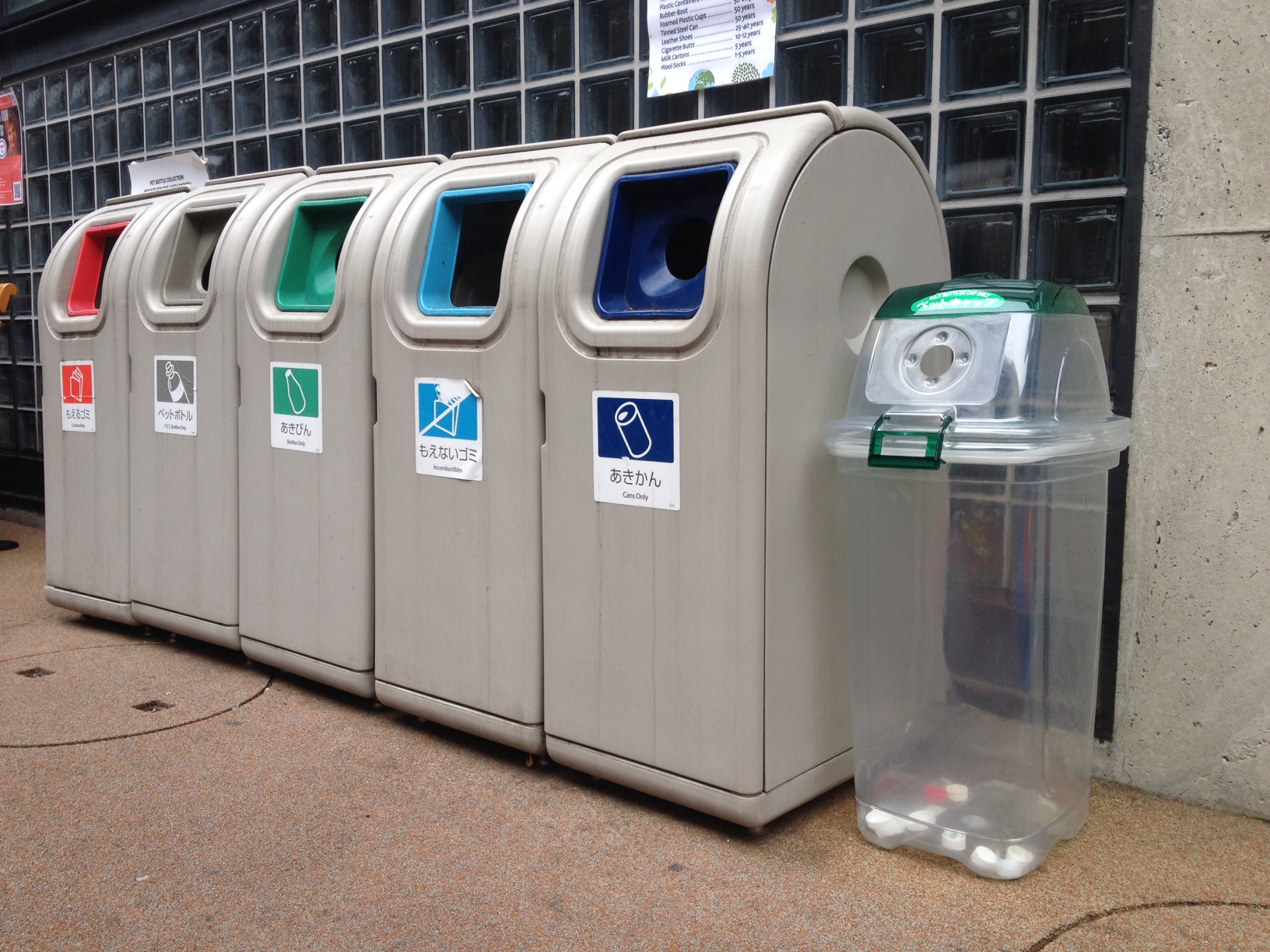
It should be no surprise that the place that spawned a New York Times best-seller dedicated to the art of tidying up should have an astonishingly elaborate system for sorting its garbage. Not content with broad categories of recycling, Japan asks people to sift categories of waste into an elaborate dichotomy that requires a diligent household to have up to a dozen piles, lest the juice cartons contaminate the miso boxes, or the plastic bento trays interfere with the empty drink bottles.

Sorting through garbage has become part of the Japanese experience. Where many other parts of the world cluster recyclable things together when they leave the home, and only sort things downstream, Japan has opted to put the burden firmly on the shoulders of individuals.

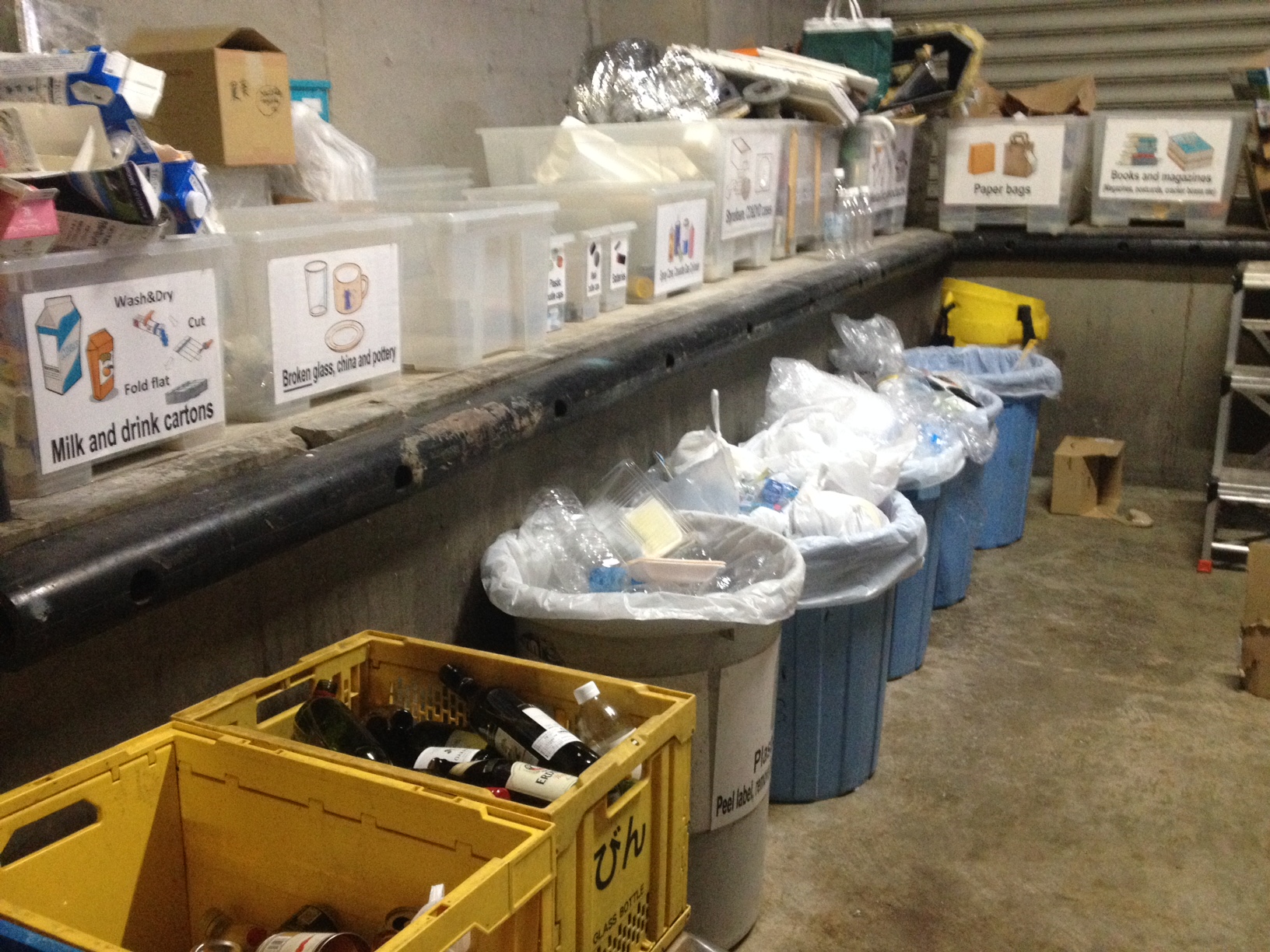
Embassy recycling bins
It’s enough to trigger OCD.

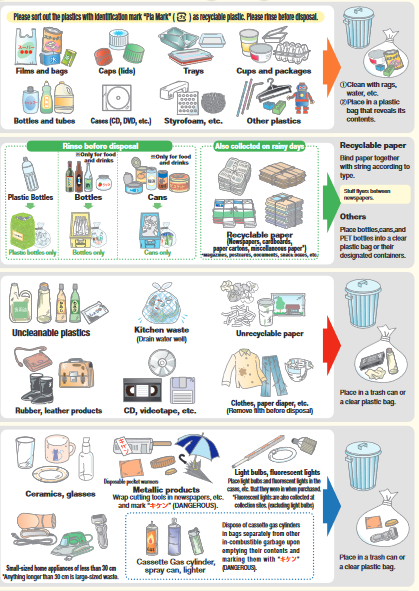
The information sheet issued by the ward administration in our part of Tokyo does a heroic job of explaining the different categories into which trash must be sorted.

So what are the Dirty Dozen? There’s glass, cans, plastic bottles, other plastic, newspaper, cardboard, drink cartons, books and magazines, batteries, rags – and then whatever doesn’t fit into these categories is separated into burnable or non-burnable. Got all that?

Recycling instructions
Apparently avoiding garbage duty is why some Japanese become ascetic.

Adding to the complexity is the schedule of garbage collection, in which different categories are collected on different days, sometimes with differing frequency. It is little wonder that one of the objections some locals have to Airbnb leases in their neighbourhood is that non-locals will not follow the garbage disposal rules properly.

And things don’t get much easier when you leave the house. Public bins are scarce in parks and at railway stations, so people are expected to carry their garbage until they find a suitable spot to dispose it, or a sufficiently discreet enough spot that they can leave it without fear of discovery.

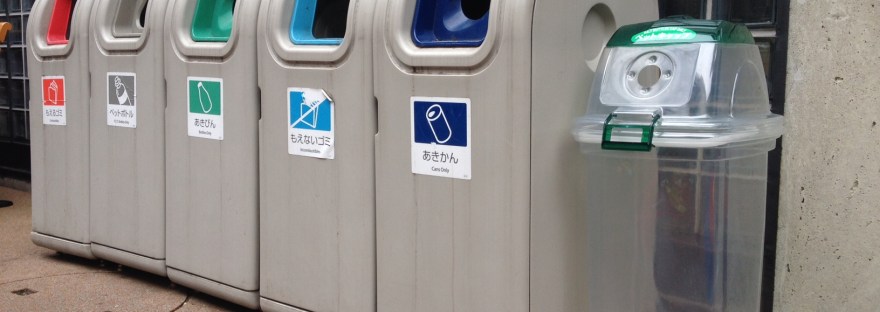
When you do finally find a recycling station, they look a bit like this:

School recycling bins
Would you risk the humiliation of getting this one wrong?

Self-serve restaurants expect patrons to sort out their leftovers in garbage at elaborate disposal stations, prompting each patron to form a snap judgement about the combustibility of each item on their tray, haunted by the social opprobrium that may be directed their way should they make a bad call.

The success of the Japanese system relies on a strong popular willingness to comply. Sorting garbage is tricky, messy and time-consuming. It relies not only on most people knowing the rules – which itself depends on good communications and high rates of literacy – but also on caring about the rules.

An ingrained commitment to rules and confidence in the fairness of the system is needed to achieve such a high rate of compliance, all the more so when the act of sorting garbage is basically private, involving only the sacred bond between trash-chucker and garbo.

In public places, people in many parts of the world have come to expect an abundance of easily accessible bins. Take those bins away, or make them complex to use, and some people believe they have been relieved of their obligation to clean up after themselves.

And yet, in Japan it works: the streets are spotlessly clean, non-compliance is rare and recycled materials are commonplace. In fact, it has helped turn Japan into a global leader in recycling strategy, prompting others around the world to consider if they can take a leaf from Japan’s book.

It is tricky to find good data on how countries compare in their trash habits, but some World Bank numbers look pretty good for Japan. Japan generates 1.71 kilos of municipal solid waste per person per day, less than most other developed countries including Australia (2.23 kilos), Germany (2.11 kilos) and the United States (2.58 kilos). And in sending just 3 per cent of its total waste to landfills, it is one of the lowest the world.

Curiously, 74 per cent of its total waste is reportedly used in energy production. There’s an excellent explainer on that – and more – over at Tofugu:

If you hear the words “fluidized bed” in relation to Japan, you might think you’re reading an article about Love Hotels. Sorry to disappoint, but at least fluidized bed combustion is pretty exciting. It is a very efficient way of burning materials that don’t normally burn easily. Your carefully sorted rubbish will be suspended in a hot, bubbling bed of ash and other particulates as jets of air are blown through it. Apparently the “fast and intimate mixing of gas and solids promotes rapid heat transfer and chemical reactions within the bed.” Who ever said garbage disposal wasn’t sexy?

All joking aside, this thermal treatment of municipal solid waste does have some advantages over other forms of incineration. It is cheaper, takes up less space, and produces fewer nitrogen oxides and less sulphur dioxide. One of them was even built near Shibuya station in 2001. It can also be used as part of a Waste to Energy system, using the resultant heat to create power.

What has promoted Japan to take such a zealous approach to recycling? As the saying goes, necessity is the mother of recycling – or something like that. A report from the Institution of Environmental Sciences pinpointed three reasons why Japan has become a leader:

  • High population density and limited landfill space;
  • Very limited domestic metal and mineral resources, making remanufacturing and recycling attractive;
  • A business culture emphasising collaboration, leading to a comprehensive approach, both to measurement and to action.

There is one piece of the puzzle, though, that Japan has largely ignored: reducing consumption.

Japan has fetishised packaging on consumer products to such an extent that even the simplest of products has an elaborate unboxing process that would make the most narcissistic YouTuber salivate.

Take these two apples, for sale recently at a Tokyo supermarket. The apples themselves – robust fruit that could probably fend for themselves pretty well – were resting in pink beanies, sitting on a paper tray, surrounded in a plastic wrap and then labelled, as if their apple-ness was not immediately apparent.

Japan apples
Exhibit A in the case for overpackaging.

It seems that the packaging here serves far more of a symbolic, rather than practical, function: the packaging is connoting the pristineness of the product, its separation from the wild, untamed (and, yes, dirty) natural world from which it is sourced. In other contexts, the packaging acts as a symbol of thoughtfulness, of a gift or of effortless affluence.

Take these well-packaged items to the cash register and you will almost always be offered a plastic bag in which to place them. Bring your own bag to the counter, or seek to go bag-free, and you will get the same quizzical look from the attendant as if you had just rocked up with a parrot perched upon your shoulder, a look that says “That’s not how we do things around here.”

At first glance it seems odd for a culture that takes such pride in its recycling to have so few qualms about superfluous consumption and packaging. But perhaps the recycling is used to excuse the wasteful packaging, allowing people to continue to accept layer upon layer by giving them the psychological comfort that the waste will eventually be recycled. In that way, the elaborate recycling rituals may act as an enabler for wasteful behaviour among people who just cannot bear to give it up.

This is not to say that winding back the recycling effort would force a rethink of packaging habits. It seems these excessive packaging habits are largely ingrained and will not change easily. An interesting parallel can be seen in the efforts to reduce electricity consumption in the wake of the Great East Japan Earthquake of March 2011, which put Japan’s nuclear power industry offline. For the summer that followed, offices switched off their air conditioning, shopping malls switched off their escalators and izakayas switched off their neon, cutting demand by up to 20 per cent in some places. Did this newfound austerity last? By the time I visited in the summer of 2012, things had pretty much returned to normal and have stayed that way. Some habits are too hard to break.

Japan’s commitment to recycling is impressive, and sets a benchmark for the rest of the world. Couple that with reduced consumption, though, and the results could be even better.

Keen for more trivia on trash in Japan? Check out this excellent collection.